Use a spiral point tap set at $59.95 for through holes and blind holes where you can clear the tap often, since it pushes chips ahead and out. Use an IRWIN hand tap and die set at $47.86 for true blind holes where chips must curl up and out of the flutes instead.
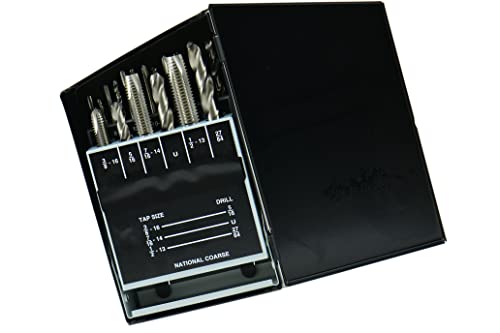
SHARS U.N.C. 18 pcs HSS Spiral Point Tap/Drill Set 404-7207 P
Check price on AmazonThe two options side by side
SHARS U.N.C. 18 pcs HSS Spiral Point Tap/Drill Set 404-7207 P
An 18-piece HSS spiral point tap and drill set. The angled point on the tip shears chips forward, pushing them ahead of the tap and out the far end of the hole, which is why this style is also called a gun tap.
Check price on Amazon
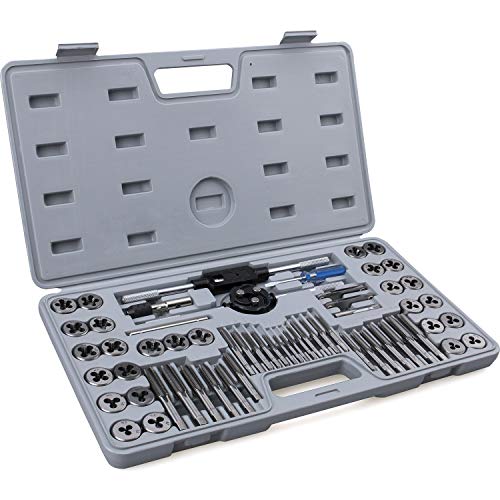
IRWIN Tap And Die Set
A 12-piece fractional tap and die set with traditional straight-flute taps. Chips curl up into the flutes as you cut, which is why a hand tap needs backing off every turn or two to clear them, especially in a blind hole.
Check price on AmazonReach for a spiral point tap on through holes or any hole deep enough that clearing chips forward saves real time, which covers most tapping done on a drill press or in a lathe tailstock. Reach for a traditional hand tap on blind holes where pushing chips forward would just pack them against the bottom of the hole, and back the tap off every turn or so to break and clear the chip.
What actually makes a spiral point tap different?
A spiral point tap, often called a gun tap, is ground with an angled point at the tip rather than straight flutes cut all the way through. That angle shears the chip and directs it forward, ahead of the tap, so chips exit out the bottom of a through hole instead of packing into the flutes. This lets you run the tap in one continuous motion without backing off to clear chips, which is a real time savings on repetitive tapping jobs.
A traditional hand tap has straight flutes the full length of the tap, and chips curl up into those flutes as the tap advances, which means the flutes fill and eventually jam the tap if you do not periodically back it out to break and clear the chip.
| Factor | Spiral point tap | Hand tap |
|---|---|---|
| Chip direction | Pushed forward, ahead of tap | Curls up into flutes |
| Best hole type | Through holes | Blind holes |
| Backing off to clear chips | Rarely needed | Needed every turn or two |
| Typical set price | $59.95 | $47.86 |
Why does hole type matter so much for tap choice?
In a through hole, a spiral point tap's forward-pushed chips have somewhere to go, straight out the far side, which is exactly why this style excels there and cuts faster with less backing off. In a blind hole, that same forward-pushed chip has nowhere to exit and instead packs down against the bottom of the hole, which can jam the tap, break it off, or damage the thread's last few turns.
A traditional hand tap's upward-curling chip is the better match for a blind hole because backing the tap off periodically lifts those chips up and out of the hole opening instead of packing them deeper.
Does tap style change how you calculate the tap drill size?
No. Tap drill size depends on the thread pitch and desired percentage of thread engagement, not on whether the tap is spiral point or straight flute, since both cut the same thread form to the same major and minor diameter. Use the tap drill calculator or the tap drill chart the same way regardless of which tap style you are using.
What does change is technique: a spiral point tap can often be run in a continuous, steady motion, while a hand tap benefits from the traditional two-forward, one-back rhythm to keep chips clearing.
Can I use a spiral point tap on a blind hole anyway?
You can, but you need to tap to a shallower depth than the drilled hole bottom and back the tap out periodically anyway to check and clear any chip buildup, since the tap's forward-pushing action works against you once there is nowhere left for the chip to go. Many home shops keep both styles on hand and choose based on the specific hole rather than committing to one style for every job.
For threading a full set of common sizes without guessing, how to tap a hole covers drill size, lubrication and depth for both blind and through holes.
| Hole type | Recommended tap style |
|---|---|
| Through hole | Spiral point |
| Blind hole, shallow | Hand tap, or spiral point with care |
| Blind hole, deep | Hand tap |
Shop the tools for this
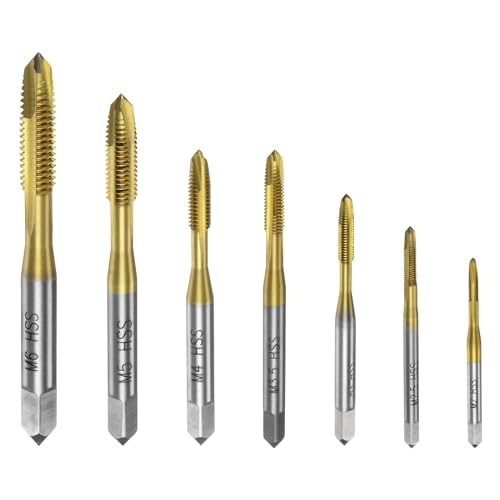
An even spread across the price range, cheapest to premium.



Frequently asked questions
Is a spiral point tap faster to use than a hand tap?
Yes, on a through hole a spiral point tap can generally be run in one continuous motion since its forward-pushed chips exit the far side of the hole, while a hand tap needs to be backed off every turn or two to clear chips curling into its flutes. That backing-off step adds real time on a job with many holes to tap.
Will a spiral point tap break more easily in a blind hole?
It can, since forcing a spiral point tap deeper into a blind hole packs its forward-pushed chips against the hole bottom with nowhere to go, and that packed chip mass can jam the tap and snap it off if you keep advancing. Stop well short of full depth or switch to a hand tap for true blind holes to avoid this failure.
What is a bottoming tap and how does it fit into this comparison?
A bottoming tap has almost no taper at its tip and threads nearly to the very bottom of a blind hole, unlike either the spiral point or the tapered hand tap discussed here, both of which leave a few unthreaded turns at the bottom. Bottoming taps are typically used as a second pass after starting the hole with a tapered tap, not as a starting tap on their own.
Do I need cutting fluid for both tap styles?
Yes, tapping fluid or cutting oil matters for both spiral point and hand taps, since it reduces friction, helps evacuate chips, and extends tap life regardless of flute style. Skipping lubrication is one of the most common causes of a broken tap in either style, especially in harder materials like stainless steel.
Can I use a spiral point tap by hand with a tap wrench?
Yes, spiral point taps work fine in a hand tap wrench and are not limited to machine or drill press use, though their advantage of continuous cutting without backing off is easiest to feel when tapping a through hole with steady, even rotation. A tap guide or tapping in a drill press chuck by hand helps keep the tap started square either way.
Keep going
More comparisons
- 7x14 vs 8x16 mini lathe
- Carbide vs HSS lathe tools
- Digital vs dial caliper
- Caliper vs micrometer
- Dial indicator vs dial test indicator
- ER32 vs 5C collets
- Portable bandsaw vs 4x6 horizontal bandsaw
- Cobalt vs titanium drill bits
Researched from published specifications, standards and verified owner reviews. Not professional advice. How we research.