Buy the WEN portable band saw at $129.27 if you need to cut stock on the bench, in the field, or on parts already mounted in a lathe or vise. Buy the WEN 4x6 horizontal bandsaw at $509.44 if you cut a lot of stock and want hands-free, square, repeatable cuts.
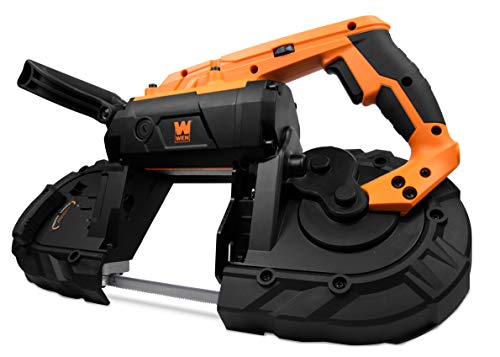
WEN Portable Band Saw for Metal
Check price on AmazonThe two options side by side
WEN Portable Band Saw for Metal
A 10-amp handheld band saw with variable speed and roughly 5 inch round cutting capacity. Lightweight, cheap to buy, and able to cut stock right where it sits instead of carrying material to a stationary saw.
Check price on Amazon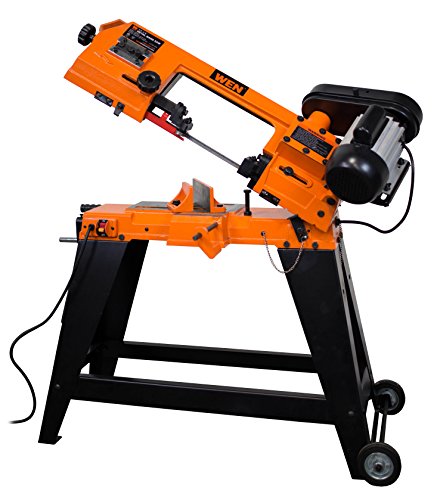
WEN Metal Band Saw with Stand
A stationary metal cutting bandsaw with a stand, sized for round stock up to about 4.5 inches and rectangular stock up to about 6 inches. Clamps the material and lowers the blade automatically for a hands-free, square cut.
Check price on AmazonA portable bandsaw is the better first purchase for a small shop cutting stock occasionally, since it costs a fraction of a stationary saw and stores in a drawer. A 4x6 horizontal bandsaw earns its bench footprint once you are cutting stock regularly, since it produces squarer cuts with no hand-holding and handles larger cross-sections a portable saw cannot manage safely.
How do capacity and cut quality actually compare?
A portable bandsaw like this WEN model cuts round stock up to roughly 5 inches, guided entirely by hand, which means cut squareness depends on how steady you hold the saw. A 4x6 horizontal bandsaw clamps the stock in a vise, then the blade lowers under its own weight or a feed control, cutting a straight, square face every time without the operator holding anything but the on switch.
For stock that needs a truly square face, for facing before chucking in a lathe or for batches of same-length cuts, the stationary saw's clamped, gravity-fed cut wins consistently over a hand-held pass.
| Factor | Portable bandsaw | 4x6 horizontal bandsaw |
|---|---|---|
| Round capacity | About 5 inch | About 4.5 inch |
| Rectangular capacity | Limited by hand control | About 6 inch |
| Cut squareness | Depends on operator | Consistent, clamped |
| Footprint | Fits in a drawer | Needs its own stand or bench space |
Which one should a small home shop buy first?
For a shop with limited space and an occasional need to cut stock to rough length before turning or milling, a portable bandsaw covers that job at a fraction of the cost and none of the floor space of a stationary saw. It also goes where the work is, cutting a bar still clamped in a bench vise or trimming stock too long to fit under a stationary saw's throat.
Once metal cutting becomes a regular, recurring task rather than an occasional one, the time saved by a hands-free, square cut on a stationary 4x6 starts to outweigh its higher price and larger footprint.
What kind of cuts does a 4x6 horizontal saw handle that a portable saw cannot?
A 4x6 saw's clamped vise and larger frame let it cut rectangular bar and larger diameter round stock that a handheld saw struggles to hold steady against, and its gravity-fed or motorized downfeed produces a consistently square cut face batch after batch, useful when facing multiple blanks to the same length for a production run of small parts. Its miter vise on many models also lets it cut angles accurately, a cut that is difficult to hold true freehand with a portable saw.
Weigh actual stock and finished part on the metal weight calculator before choosing stock size, since heavier bar stock is easier to manage clamped in a stationary saw than braced by hand under a portable one.
Does a portable bandsaw replace a stationary saw for good?
Not entirely. A portable bandsaw remains useful even in a shop that owns a stationary saw, since it reaches stock too long or awkwardly shaped to fit a stationary saw's vise and throat, and it works away from the bench entirely, cutting conduit, angle iron or a part already installed. Many home shops end up owning both: the portable saw for reach and flexibility, the stationary saw for volume and squareness.
If budget only allows one to start, match the choice to how you actually cut stock today rather than the capability you might want someday.
What blade should you keep on hand for each saw type?
Blade tooth pitch matters more than the saw itself for cut quality and blade life, and both portable and stationary bandsaws use the same basic rule: thinner stock needs a finer pitch so at least two or three teeth are always in contact with the material, while thicker stock can run a coarser pitch that clears chips faster. A bimetal blade in an 14 to 18 tooth per inch range covers most mixed hobby stock on either saw type, with a coarser 10 tooth blade reserved for thicker solid bar.
Keep at least one spare blade for each saw on the shelf, since a dull or damaged blade is the most common reason a bandsaw starts wandering off a square cut on either machine.
Shop the tools for this
An even spread across the price range, cheapest to premium.



Frequently asked questions
Can a portable bandsaw cut as square as a stationary 4x6?
Not reliably, since a handheld saw's cut squareness depends entirely on how steady the operator holds it against the stock, while a stationary saw clamps the material and lowers the blade under controlled, consistent pressure. For parts that need a truly square face without further facing on a lathe, a stationary saw produces a more consistent result cut after cut.
What blade speed should I use cutting steel with a bandsaw?
Blade speed depends on the material and blade tooth pitch, with denser, harder metals like steel needing a slower blade speed than softer metals like aluminum to avoid overheating the teeth. Check the manufacturer's recommended speed range for your specific blade and material before cutting, and favor the slower end of the range when starting on an unfamiliar stock.
Is a 4x6 horizontal bandsaw worth it for occasional hobby use?
If you cut metal stock only a few times a project, the cost and bench space of a 4x6 saw are hard to justify next to a portable bandsaw that does the same basic job for far less money and no dedicated floor space. It becomes worth it once cutting stock to length is a frequent, recurring part of your workflow rather than an occasional step.
What is the difference between horizontal and vertical mode on a 4x6 saw?
Horizontal mode lowers the blade down through clamped stock for straight cutoff work, the saw's main job, while vertical mode locks the blade upright so the table becomes a small bandsaw for contour or freehand cutting, similar in concept to a woodworking bandsaw. Most 4x6 saws switch between the two modes, adding some shop versatility beyond simple stock cutoff.
Can a portable bandsaw cut stainless steel?
Yes, with a bimetal blade rated for stainless and a slower cutting speed than you would use on mild steel, since stainless work-hardens quickly and generates more heat under the blade. Keep steady, even pressure and avoid stalling the blade mid-cut, which both accelerates blade wear and risks binding in the harder material.
Keep going
More comparisons
- 7x14 vs 8x16 mini lathe
- Carbide vs HSS lathe tools
- Digital vs dial caliper
- Caliper vs micrometer
- Dial indicator vs dial test indicator
- ER32 vs 5C collets
- Spiral point vs hand taps
- Cobalt vs titanium drill bits
Researched from published specifications, standards and verified owner reviews. Not professional advice. How we research.