Start with a single Starrett 0-1" outside micrometer at $86.01: it is the classic buy-once size for checking turned diameters and press fits, and most hobby parts fall inside that one inch of range.

Starrett Outside Micrometer with One-Piece Spindle
A 0-1" outside micrometer is the size every machinist reaches for most, since the bulk of hobby turning happens under an inch in diameter. The Starrett 436.1XRL-1 has a one-piece spindle that resists the wobble cheaper micrometers develop over time, a satin chrome finish, and the same 0.001" graduation as far pricier options. It is the size to own before a multi-piece set, because a set spreads the same budget across ranges you may not need yet.
Check price on AmazonThe three picks at a glance
| Tier | Pick | Price |
|---|---|---|
| Beginner | General Tools 102 0-Inch to 1-Inch .001-Inch Graduation Micrometer | $17.69 |
| Intermediate | Starrett Outside Micrometer with One-Piece Spindle | $86.01 |
| Expert | Mitutoyo 293-340-32 Coolant-Proof Digimatic Micrometer | $175.00 |
Beginner: Best first micrometer
Who it is for: A hobbyist who has been using a caliper and needs their first micrometer to check a turned diameter more precisely.
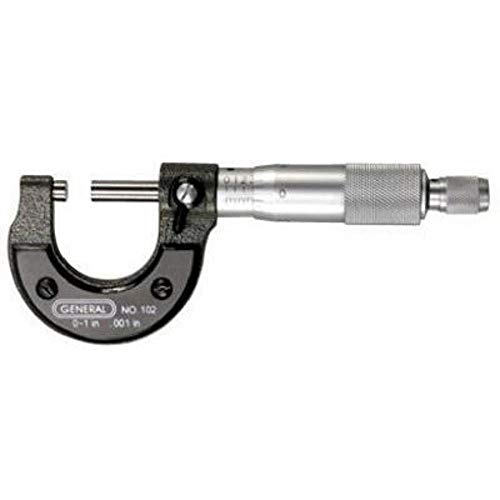
General Tools 102 0-Inch to 1-Inch .001-Inch Graduation Micrometer
The General Tools 102 0-1" Micrometer at $17.69 is a simple, well-known mechanical micrometer with 0.001" graduation, enough to learn proper micrometer technique and check diameters far more precisely than a caliper.
Check price on AmazonSkip it if: Anyone who wants a ratchet stop for consistent measuring pressure or 0.0001" graduation.
Intermediate: Buy once
Who it is for: Someone turning parts regularly who wants a micrometer that holds calibration for years without a second thought.
Starrett Outside Micrometer with One-Piece Spindle
The Starrett 436.1XRL-1 Outside Micrometer at $86.01 has a one-piece spindle and quick, precise sleeve adjustment from a brand machinists have trusted for a century, at 0.001" graduation over a 0-1" range.
Check price on AmazonSkip it if: Anyone who needs digital readout or 0.0001" resolution for tight-tolerance fits.
Expert: Performance ceiling
Who it is for: A machinist checking tight fits and thread diameters who wants a digital readout with coolant protection.

Mitutoyo 293-340-32 Coolant-Proof Digimatic Micrometer
The Mitutoyo 293-340-32 Coolant-Proof Digimatic Micrometer at $175.00 adds a digital display, coolant-proof construction, and Mitutoyo's Absolute encoder to a 0-1" range, removing the interpolation a vernier scale requires.
Check price on AmazonSkip it if: Anyone whose parts rarely need better than 0.001" resolution; the extra digit is wasted on rough turning.
What size micrometer do you actually need first?
A 0-1" outside micrometer covers the diameter range of most hobby lathe work: small shafts, bushings, and stock under an inch. Buying a 4-piece set (0-4") before you have a project that needs 2, 3 or 4 inch stock just spreads the same budget thinner across ranges that may sit unused for years.
Add a second range only when a specific project calls for it. A single well-made 0-1" micrometer measures more precisely, on average, than the same-priced set spread across four ranges, because the maker concentrates quality into one instrument instead of four.
0.001" or 0.0001" graduation: does it matter for hobby work?
For most turning, 0.001" graduation is plenty; that is one thousandth of an inch, tighter than most hobby fits need. 0.0001" graduation matters when fitting a bearing, cutting a precise thread major diameter, or checking a slip fit that has to be right the first time.
A 0.001" micrometer and a 0.0001" ratchet micrometer cost roughly the same; the choice comes down to whether your projects regularly need the extra digit, not price.
| Micrometer | Range | Graduation | Price |
|---|---|---|---|
| General Tools 102 | 0-1" | 0.001" | $17.69 |
| Starrett 436.1XRL-1 | 0-1" | 0.001" | $86.01 |
| Mitutoyo 103-177 Ratchet | 0-1" | 0.001" | $64.79 |
| Mitutoyo 293-340-32 Digimatic | 0-1" | 0.0001" | $175.00 |
Vernier, ratchet or digital: which reads fastest and most consistently?
A plain vernier micrometer requires reading two scales and interpolating between lines, which is where beginners lose accuracy. A ratchet stop, like the Mitutoyo 103-177, applies the same measuring pressure every time by slipping once a set torque is reached, removing the biggest source of operator-to-operator variation. A digital micrometer removes the interpolation step entirely and displays the reading directly.
None of the three is wrong; a ratchet-stop micrometer is the best upgrade path for someone who already reads a vernier scale comfortably but wants more repeatable pressure.
How do you keep a micrometer accurate for the long term?
Store a micrometer in its case with the anvil and spindle backed off slightly so they are never left clamped tight, which can cause the frame to creep out of true over years of storage. Wipe the measuring faces before every use; a single trapped chip throws off the reading and can mar the anvil face.
Check zero at the fully closed position periodically, and if a micrometer is dropped, verify it against a known standard, such as gauge blocks, before trusting it on a critical dimension again.
Also worth considering
- Beaiguna 4PCS Micrometer Set ($47.99): A 4-piece 0-4" micrometer set for a shop that needs to check larger stock diameters without buying each size separately.
- Accusize Outside Micrometer Set 0-4 in x 0.0001 in 4 Pc Set ($144.00): An Accusize 4-piece 0-4" set at a higher price point with tighter published tolerances than the budget sets.
- Mitutoyo 103-177 ($64.79): A Mitutoyo 0-1" ratchet-stop micrometer for consistent measuring pressure without the digital display.
- Mitutoyo 128-105 Vernier Depth Gauge ($118.00): A Mitutoyo vernier depth gauge, the micrometer-type tool to reach for when the measurement is a hole or shoulder depth instead of an outside diameter.
More options across the price range
Chosen as an even spread from the cheapest to the most expensive listing in this category.


How we chose
Every micrometer here comes from the site catalog of currently listed Amazon products. Selections are based on published range, graduation, ratchet or digital features, and brand reputation drawn from manufacturer specifications and verified owner reviews, not any in-house testing.
The 0-1" size is emphasized because it is the range that covers the largest share of hobby turning projects; multi-piece sets and larger single ranges are included as alsoConsider options for shops that have outgrown a single micrometer.
Buying tips
Should your first micrometer be part of a set?
No, for most hobbyists. A single 0-1" micrometer covers the bulk of early projects; add ranges once a project actually needs them.
Is a ratchet stop worth paying extra for?
Yes, if consistent measuring pressure across sessions matters to your work; it removes the biggest source of reading-to-reading variation for a hand-tightened micrometer.
Digital or mechanical for a first micrometer?
Mechanical is fine and cheaper, and it teaches proper technique. Digital saves time reading the scale once you already understand what the numbers mean.
How do you store a micrometer between uses?
In its fitted case, faces backed off from full contact, away from coolant and swarf, ideally in the same tool chest as your calipers and indicators.
Get these picks by email
Every item on this page with its current price in one email, so you can buy the shop in stages. No sales sequence.
Used only to send the list.Frequently asked questions
What is the difference between a caliper and a micrometer?
A caliper measures a wide range quickly at roughly 0.001 inch practical accuracy, while a micrometer measures a single narrow range with much finer real-world repeatability. Use a caliper for general stock checks and layout, and a micrometer when a diameter has to fit another part precisely, such as a bearing bore or a thread major diameter. See the caliper vs micrometer comparison for more detail.
Do I need a 0-1" and a 1-2" micrometer, or just one?
Start with a 0-1" micrometer; it covers the diameter range of most hobby lathe work. Add a 1-2" or a full multi-piece set only once a specific project calls for stock larger than one inch, since a single well-made 0-1" instrument is usually a better first purchase than a set spread thin across ranges.
How accurate is a $17 micrometer really?
A basic mechanical micrometer like the General Tools 102 reads to the same 0.001 inch graduation as far more expensive models and is accurate enough to learn on and use for everyday hobby turning. The gap versus a Starrett or Mitutoyo shows up in long-term durability and consistency of the spindle and anvil faces, not the number on the scale.
What does a ratchet stop actually do?
A ratchet stop is a small clutch built into the thimble that slips once a consistent, light measuring pressure is reached, so the micrometer closes on the part the same way every time regardless of who is turning it. It removes over-tightening as a source of measurement error, which matters most when comparing readings taken at different times.
Is a digital micrometer more accurate than a mechanical one?
Not necessarily more accurate, but more repeatable to read, since it removes vernier scale interpolation. A well-made mechanical micrometer and a digital one of the same graduation measure a part to the same real-world tolerance; the digital display simply removes the chance of misreading the scale.
Keep going
Researched from published manufacturer specifications, listing details and verified owner reviews. Not hands-on testing and not professional advice. How we research.