For most mini lathe owners adding independent 4-jaw capability, the LittleMachineShop 4 inch 4-jaw independent chuck with adapter at $142.94 includes the chuck key and reversible jaws in one purchase built specifically for this size class.

Lathe Chuck
A 3-jaw chuck self-centers but cannot true up an off-center or irregular part; a 4-jaw independent chuck lets each jaw move separately so you can dial in a part to true center with a dial indicator, which is essential for repair work, off-center turning, and squaring up rough castings. This LittleMachineShop chuck is sold with a mini-lathe-specific adapter, a chuck key, and reversible jaws already included, which removes the guesswork of matching a generic 4-jaw chuck to your spindle mount. LittleMachineShop specializes in parts and accessories for exactly this class of lathe, which matters for fit and for finding replacement jaws later if one is ever damaged.
Check price on AmazonThe three picks at a glance
| Tier | Pick | Price |
|---|---|---|
| Beginner | Yunnergo K72-100 Lathe Independent Chuck 4 Inch Chuck 4 Jaw 3500 r/min | $52.77 |
| Intermediate | Lathe Chuck | $142.94 |
| Expert | Shars 8" 4 Jaw Independent Lathe Chuck D1-4 TIR Runout New 202-5425 R[ | $252.00 |
Beginner: Lowest-cost independent chuck
Who it is for: A mini lathe owner adding a first 4-jaw independent chuck on a tight budget.
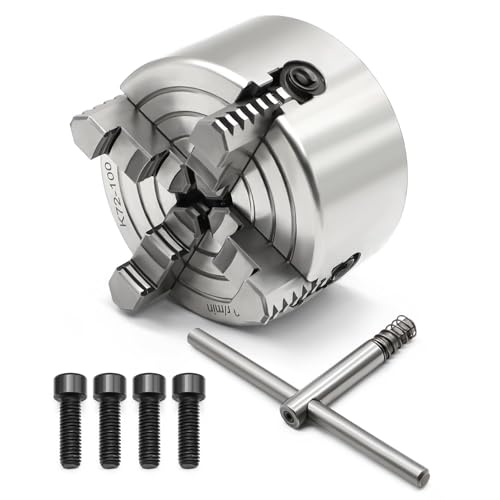
Yunnergo K72-100 Lathe Independent Chuck 4 Inch Chuck 4 Jaw 3500 r/min
A 4 inch K72-100 independent 4-jaw chuck rated to 3,500 RPM, priced well below the mini-lathe-specific options. It gives you the core capability, dialing in off-center or irregular stock, at the lowest entry cost in this category.
Check price on AmazonSkip it if: Anyone who wants a guaranteed direct fit and included adapter for their specific mini lathe spindle; confirm your spindle thread or mount type separately before ordering a generic chuck like this one.
Intermediate: Buy once
Who it is for: A mini lathe owner who wants a chuck built and sold specifically for this size class, with the adapter, key, and jaws already matched.
Lathe Chuck
Sold as a matched kit for mini lathes with the spindle adapter, chuck key, and reversible jaws included, which removes the fitment risk of buying a generic industrial chuck and hoping the mount matches. Reversible jaws let you grip both outside diameters and, reversed, larger bores or odd shapes from the inside.
Check price on AmazonSkip it if: Owners of larger benchtop lathes with a bigger spindle mount; this kit is sized and adapted specifically for the mini lathe class.
Expert: Performance ceiling
Who it is for: An owner of a larger benchtop lathe who needs an 8 inch 4-jaw chuck with a D1-4 camlock mount and tight runout.

Shars 8" 4 Jaw Independent Lathe Chuck D1-4 TIR Runout New 202-5425 R[
An 8 inch 4-jaw independent chuck with a D1-4 camlock mount from Shars, an established industrial tooling brand, with tight total indicated runout (TIR) specified on the listing. The larger jaw capacity and D1-4 mount match bigger benchtop lathes rather than the mini lathe class, and the tighter runout spec matters for precision work where a few thousandths at the jaw shows up directly in the finished part.
Check price on AmazonSkip it if: Mini lathe owners; the D1-4 mount and 8 inch size are built for larger benchtop and industrial spindle noses, not the smaller mounts common on 7x12 through 7x16 lathes.
Why do you need a 4-jaw chuck if the lathe already has a 3-jaw?
A 3-jaw chuck self-centers automatically as you tighten it, which is fast but only works accurately on round or hex stock centered on its own axis. A 4-jaw independent chuck moves each jaw separately, so you can indicate a part in with a dial test indicator and true it up to within a thousandth of an inch, including irregular castings, off-center bores, and parts where you deliberately want an off-axis feature.
For a hobby shop, the 4-jaw is the accessory that unlocks repair work and non-symmetrical parts, which is a large share of real-world jobs beyond making new round stock into new round parts.
| Chuck type | Centers automatically | Best for |
|---|---|---|
| 3-jaw self-centering | Yes | Round and hex stock, fast setup |
| 4-jaw independent | No, dialed in by hand | Off-center work, irregular stock, precision truing |
Live centers, drill chucks, and knurling tools: what each accessory is actually for
A live center mounts in the tailstock and spins with the workpiece on its own bearings, which supports the far end of long stock turned between the chuck and the tailstock without the friction and wear a fixed dead center creates. A drill chuck with an MT2 arbor mounts in the tailstock (or in the headstock spindle on some lathes) to hold drill bits for center-drilling and boring pilot holes on the lathe. A knurling tool presses a diamond or straight pattern into a part surface for grip, common on handles, knobs, and tool handles.
None of these are optional for very long: almost every lathe project eventually needs a live center for between-centers work, and a drill chuck for center-drilling before turning is close to universal practice.
How do you actually dial in a part with a 4-jaw chuck?
Mount a dial indicator or dial test indicator on the tool post or a magnetic base, bring the tip against the outside diameter of the part near the chuck jaws, and rotate the spindle by hand while adjusting opposing jaws to minimize the indicator swing. Repeat near the front and back of the part if the stock is long, since a part can be centered at one point along its length and still be off-axis further out. Full step-by-step technique is covered in the how to indicate a part in a 4-jaw chuck guide.
Also worth considering
- Nakkaa MT2 Medium Duty Live Center Triple Bearing Lathe Medium Duty CNC ($19.17): Nakkaa MT2 medium duty live center with triple bearings at $19.17, essential for turning between centers instead of only holding stock in the chuck.
- uxcell Keyless Drill Chuck MT2 Morse Taper Mount Adjustable 1/32"-1/2" ($31.19): uxcell keyless drill chuck with an MT2 arbor at $31.19, for mounting a drill chuck in the tailstock or spindle.
- BLUEFOX TOOLS 6 Head Lathe Knurling Tool Holder 3/4 by 5-Inch... ($29.00): BLUEFOX Tools 6 head rotating knurling tool holder at $29.00, for adding a grip pattern to handles and knobs.
- Shars 4" 4 Jaw Independent Precision Chuck & 5C Arbor 202-5447 M[ ($149.95): Shars 4 inch 4-jaw independent chuck bundled with a 5C arbor at $149.95, if you also want 5C collet capability on the same mount.
More options across the price range
Chosen as an even spread from the cheapest to the most expensive listing in this category.


How we chose
Every product above is pulled from the verified Amazon catalog for this site: real ASINs, real published prices, and real listed specifications (chuck size, mount type, jaw configuration, runout where specified). None of this reflects hands-on shop testing; the recommendations are built from manufacturer specifications, listing details, and patterns across verified owner reviews.
The chuck tiers were built around fitment first, generic budget option, matched mini-lathe kit, and larger D1-4 mount for benchtop lathes, since mismounting a chuck is a more expensive mistake than any price difference between tiers.
Buying tips
How do I know what spindle mount my lathe uses?
Check your lathe manual or listing for the spindle nose specification, commonly a threaded mount (like M33 or 1 inch by 8 TPI on many mini lathes) or a camlock mount (like D1-4) on larger benchtop machines. A chuck sold for the wrong mount type will not fit no matter how good the chuck itself is.
Do I need a chuck adapter plate?
If a chuck is not sold specifically matched to your lathe, you likely need a separate backplate or adapter machined or bought for your exact spindle mount. Kits sold specifically for mini lathes, like the intermediate pick above, avoid this extra step and cost.
What is a dead center and do I still need one if I have a live center?
A dead center does not rotate and relies on lubrication between it and the workpiece, while a live center rotates on its own bearings with the part. Most hobbyists use a live center almost exclusively now since it eliminates the friction and heat buildup a dead center creates, but a dead center is still occasionally useful for very slow, precise work.
Get these picks by email
Every item on this page with its current price in one email, so you can buy the shop in stages. No sales sequence.
Used only to send the list.Frequently asked questions
What is the difference between a 3-jaw and a 4-jaw lathe chuck?
A 3-jaw chuck self-centers automatically as it tightens, which is fast for round or hex stock. A 4-jaw independent chuck has jaws that move separately, requiring you to dial the part in with an indicator, but it can center irregular stock and off-axis features a 3-jaw cannot handle at all.
Does a 4-jaw chuck fit any mini lathe spindle?
Not automatically. Chucks are sold for specific spindle mount types, either threaded or camlock, and a generic industrial chuck may not match your lathe without an adapter backplate. Kits sold specifically for mini lathes include the correct adapter already fitted.
What is a live center used for on a lathe?
A live center mounts in the tailstock and rotates on its own bearings along with the workpiece, supporting the far end of a part turned between centers without the friction a fixed dead center would create. It is standard equipment for any work longer than can be safely held in the chuck alone.
Do I need an MT2 arbor drill chuck if my lathe already has a chuck?
Yes, they serve different purposes. The main lathe chuck holds and spins the workpiece; a drill chuck with an MT2 arbor mounts in the tailstock to hold a drill bit for center-drilling and boring pilot holes into a stationary or rotating part, which the main chuck cannot do.
What runout should I expect from a lathe chuck?
Budget chucks commonly run a few thousandths of an inch of total indicated runout out of the box, while premium chucks specify tighter tolerances, sometimes under a thousandth. For most hobby work, a few thousandths is not noticeable; precision work benefits from checking the listed runout spec before buying.
Keep going
Researched from published manufacturer specifications, listing details and verified owner reviews. Not hands-on testing and not professional advice. How we research.