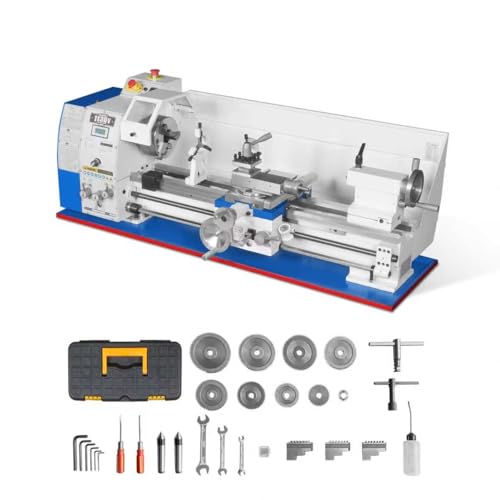
For hobbyists who have outgrown a mini lathe, the VEVOR 8.3x29.5 brushless benchtop lathe at $1099.90 delivers real bed length, a brushless motor, and an LCD display without stepping all the way up to industrial pricing.

VEVOR Metal Lathe
This is the point in the benchtop class where the upgrades that actually matter start showing up together: a brushless motor instead of a brushed one (quieter, more torque at low RPM, less maintenance), a bed long enough at 29.5 inches to handle real shaft work, and an LCD digital display instead of a dial. Buyers moving up from a mini lathe are usually chasing three things: more spindle bore so bar stock passes through the headstock, more bed length, and a motor that does not bog down on steel. This machine covers the first two directly and the brushless motor covers the third far better than the brushed 550W motors common on mini lathes. It sits below the industrial 10x22 machines in price while delivering most of the practical upgrade a hobbyist actually needs.
Check price on AmazonThe three picks at a glance
| Tier | Pick | Price |
|---|---|---|
| Beginner | 8"x16" Inch Compact Benchtop Metal Lathe 2 Axis Auto Power Feed Mini... | $609.99 |
| Intermediate | VEVOR Metal Lathe Machine | $1070.91 |
| Expert | Mechmaxx 10'' x 22'' Industrial Metal Lathe Machine with DRO High... | $3099.00 |
Beginner: First step up from a mini lathe
Who it is for: A hobbyist who has outgrown a 7x14 mini lathe but is not ready for four-figure industrial pricing.

8"x16" Inch Compact Benchtop Metal Lathe 2 Axis Auto Power Feed Mini...
An 8x16 compact benchtop lathe with 2-axis auto power feed and a high-torque variable speed motor already included, at a price close to the top of the mini lathe class rather than the bottom of the benchtop class. Auto feed on both axes means consistent surface finish on long turning passes without hand-cranking the carriage, which is the single biggest quality-of-life jump when moving up from a mini lathe.
Check price on AmazonSkip it if: Anyone who needs a brushless motor or a spindle bore large enough to pass 1 inch or larger bar stock through the headstock; this machine is sized for the swing upgrade, not the bore upgrade.
Intermediate: Buy once
Who it is for: A hobbyist who wants brushless power and auto feed together and plans to keep this lathe for years rather than upgrading again.

VEVOR Metal Lathe Machine
An 8.7x18 benchtop lathe with a 1250W brushless motor and automatic feed built in. The brushless motor holds torque at low RPM far better than brushed motors of similar wattage, which matters directly when facing large-diameter stock or threading at slow speed. Automatic feed removes the fatigue of hand-feeding long turning passes and improves finish consistency on repeat parts.
Check price on AmazonSkip it if: Buyers who specifically need the larger spindle bore or the bigger 10x22 bed of the industrial-class machines; this is a mid-size upgrade, not a full production lathe.
Expert: Performance ceiling
Who it is for: A hobbyist or small shop that wants an industrial 10 by 22 lathe with a digital readout already fitted, and has the budget and bench space for it.

Mechmaxx 10'' x 22'' Industrial Metal Lathe Machine with DRO High...
A 10x22 industrial benchtop lathe with a factory-fitted DRO, a 1.5HP brushless motor, and 0 to 2000 RPM variable speed. At this size the spindle bore is large enough for real bar stock work, the bed length supports long shafts, and the DRO removes the need to count handwheel graduations for every cut. This is the practical ceiling before a hobby machine becomes a genuine small-production lathe.
Check price on AmazonSkip it if: Anyone without dedicated shop space or 220V-class electrical for the larger motor; check the listing power requirements before buying at this size, and confirm your bench can carry the weight.
How is a benchtop lathe different from a mini lathe?
The line is fuzzy at the edges, but in practice benchtop lathes in the 8x14 through 10x22 class add three things mini lathes in the 7x12 to 7x16 class usually lack: a larger spindle bore so bar stock can feed through the headstock instead of only being held in the chuck, brushless motors that hold torque at low RPM, and automatic carriage feed as a standard feature rather than an upgrade.
The tradeoff is weight, footprint, and price. A 10x22 industrial lathe weighs several times what a 7x14 mini lathe weighs and needs a dedicated bench, not a folding table. If your projects are outgrowing a mini lathe on bore size or motor power rather than just bed length, the benchtop class is the right move.
| Feature | Typical mini lathe | Typical benchtop lathe |
|---|---|---|
| Spindle bore | Small, bar stock rarely passes through | Larger, real bar stock capacity |
| Motor type | Brushed, 500 to 800W | Often brushless, 1000W or more |
| Feed | Manual, sometimes single-axis power feed | 2-axis auto feed common |
| Typical weight | Under 100 lbs | 150 to 400+ lbs |
Why does a brushless motor matter on a lathe specifically?
A brushed motor loses torque as RPM drops, which is exactly the range where facing, parting, and threading happen. A brushless motor holds torque far more evenly across its speed range, so a slow threading pass on a large-diameter part does not bog down or stall the same way it can on a brushed benchtop lathe. Brushless motors also run quieter and do not wear brushes, which matters more on a machine that gets regular hobby use over years rather than occasional weekend runs.
Run a quick check with the cutting time calculator before committing to a heavy roughing pass at low RPM; it will show how much time a brushless motor actually saves you over a stall-prone brushed one on the same job.
What does auto feed actually change day to day?
Automatic carriage feed keeps the tool moving at a constant rate along the bed without a hand on the crank, which produces a more even surface finish on long turning passes and reduces operator fatigue on repeat parts. Two-axis auto feed adds the same benefit to facing cuts across the cross slide. It is the single feature buyers moving up from a mini lathe notice fastest, more than the extra bed length or bore size.
Combine auto feed with the feed rate calculator to dial in chip load for your material and tool before running a long automated pass; feeding too fast on an unattended power feed is a fast way to snap a carbide insert.
What spindle bore size do you actually need?
Spindle bore is the diameter of stock that can pass all the way through the headstock rather than just being held in the chuck jaws. A larger bore matters most if you regularly turn parts from bar stock that needs to feed through for repeat cuts, or if you use collets that require through-bore clearance. Check the listed spindle bore diameter directly; it is rarely the first spec buyers check but is often the reason a hobbyist upgrades from a mini lathe in the first place.
Also worth considering
- 1.5'' Spindle Bore Metal Lathe Machine with DRO 8''x 16''High... ($2099.00): MechMaxx 8x16 with a factory DRO and a 1.5 inch spindle bore for $2099.00, a strong middle option if bore size matters more than bed length.
- INTSUPERMAI Mini Metal Lathe 8"×16" Inch/Metric Benchtop Lathe... ($1459.00): INTSUPERMAI 8x16 with electronic gearless metric and inch switching plus both a 4-jaw and 3-jaw chuck included, at $1459.00.
- EQCOTWEA Double-Chuck Metal Lathe 8"x30" Precision Bench Lathe... ($1825.00): EQCOTWEA 8x30 double-chuck lathe with a grating ruler scale for $1825.00, for extra-long bed work.
More options across the price range
Chosen as an even spread from the cheapest to the most expensive listing in this category.


How we chose
Every machine above comes from the verified Amazon catalog for this site, matched by real published bed length, swing, motor type, and spindle bore or DRO listings. None of this reflects hands-on testing; the comparisons are built from manufacturer specifications, listing details, and patterns across verified owner reviews.
Tiers were built to track the actual upgrade path buyers describe: swing and auto feed first, then brushless power and bore size, then full industrial 10x22 capability with a factory DRO. Premium models are included deliberately rather than only the cheapest options, since the benchtop-versus-mini-lathe decision is itself a premium buy.
Buying tips
Do you need 220V power for these lathes?
Check each listing individually. Many machines in the 8 to 10 inch swing class still run on standard 110V household circuits, but the larger brushless motors on some 10x22 models require 220V. Confirm before ordering, since running the wrong voltage is not a simple fix after delivery.
Is a factory DRO worth paying extra for?
Yes, if you can find it in your price range. A digital readout removes the need to count handwheel graduations for every cut, which saves real time on repeat parts and reduces measurement error on precision work. Retrofitting one later costs more than paying for it up front on a machine that already has it.
How much bench or floor space does a 10x22 lathe need?
Plan for the full bed length plus at least 12 to 18 inches of clearance on each end for tailstock travel and material overhang, plus room to stand and operate the carriage handwheels comfortably. These machines are heavy enough that moving one after installation is a real project, so measure the space before ordering.
Get these picks by email
Every item on this page with its current price in one email, so you can buy the shop in stages. No sales sequence.
Used only to send the list.Frequently asked questions
What counts as a benchtop metal lathe versus a mini lathe?
There is no strict line, but benchtop lathes typically start around 8 inch swing and add features like larger spindle bore, brushless motors, and standard 2-axis power feed. Mini lathes are usually 7 inch swing class with smaller bore and brushed motors. The benchtop class targets buyers who have outgrown a mini lathe.
Why would I need a bigger spindle bore?
A larger spindle bore lets bar stock pass through the headstock rather than only being clamped in the chuck jaws, which matters for repeat parts cut from long stock and for use with certain collet systems. If your work is mostly short individual pieces held in a chuck, bore size matters less.
Are brushless motors worth the extra cost on a lathe?
Generally yes for regular use. Brushless motors hold torque better at low RPM, which is exactly where facing, parting, and threading happen, and they avoid the brush wear and maintenance that brushed motors need over years of hobby use. The cost premium is usually a few hundred dollars over a comparable brushed machine.
Do benchtop lathes in this class cut both metric and imperial threads?
Most do, through a change gear train or, on higher-end models, electronic gearless switching between metric and imperial pitches. Check the specific listing for the supported thread pitch range, since it varies by model even within the same size class.
What is the practical size ceiling before a lathe stops being a hobby machine?
Around 10x22 with a 1.5 to 2HP motor is generally the largest size that still fits typical garage or home shop space and single-person operation. Beyond that, weight, power requirements, and footprint start moving into small-production territory rather than hobby use.
Keep going
Researched from published manufacturer specifications, listing details and verified owner reviews. Not hands-on testing and not professional advice. How we research.