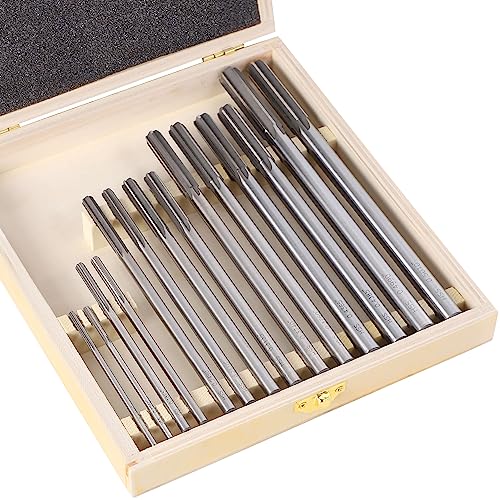
The Kimllier 10-piece metric H7 reamer set at $25.09 covers 3mm to 12mm in the sizes most hobby bushings, dowel pins, and shaft fits call for, at a price that makes owning a full set practical.

Kimllier 10Pcs Chucking Reamer Set 3-12mm HSS H7 Reamer Set Cutter...
Chucking reamers remove a small, controlled amount of material from a drilled hole to bring it to an exact, round, smooth-walled final diameter that a twist drill alone cannot reliably produce. This 10-piece set covers 3mm to 12mm, the range that matches most hobby dowel pin, bushing, and shaft fits, in H7 tolerance suitable for a sliding or light press fit. Drill 0.2mm to 0.4mm under the finished size and let the reamer take the rest; the RPM calculator helps pick a conservative reaming speed.
Check price on AmazonThe three picks at a glance
| Tier | Pick | Price |
|---|---|---|
| Beginner | uxcell Chucking Reamer Set Lathe Machine Reamer Straight Flute... | $23.79 |
| Intermediate | Kimllier 10Pcs Chucking Reamer Set 3-12mm HSS H7 Reamer Set Cutter... | $25.09 |
| Expert | Accusize Industrial Tools 14 Pc Over and Under Size H.S.S. Chucking... | $128.00 |
Beginner: Best first set
Who it is for: someone who occasionally needs a precise round hole for a dowel pin or bushing and does not want a large kit
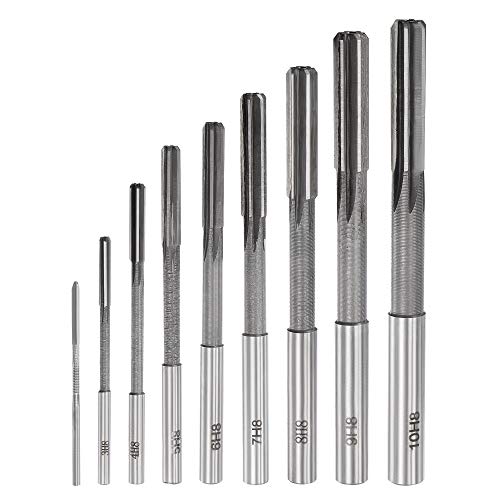
uxcell Chucking Reamer Set Lathe Machine Reamer Straight Flute...
The uxcell 9-piece metric H8 set at $23.79 covers 2mm to 10mm at a looser H8 tolerance, which suits general clearance fits and costs less than a tighter-tolerance set.
Check price on AmazonSkip it if: a precision sliding or press fit that specifically needs H7 tolerance
Intermediate: Buy once
Who it is for: a hobbyist making bushings, dowel pin holes, and shaft fits regularly across the common metric sizes
Kimllier 10Pcs Chucking Reamer Set 3-12mm HSS H7 Reamer Set Cutter...
The Kimllier 10-piece metric H7 set at $25.09 tightens tolerance to H7, suitable for sliding and light press fits, across the 3mm to 12mm range that covers most hobby project needs in one purchase.
Check price on AmazonSkip it if: fractional inch sizes; buy a fractional set instead if your drawings are dimensioned in inches
Expert: Performance ceiling
Who it is for: a machinist who needs precise fractional sizes across a wide range for repeated production of fitted parts

Accusize Industrial Tools 14 Pc Over and Under Size H.S.S. Chucking...
The Accusize 14-piece fractional set at $128.00 spans 0.1240 in to 0.5010 in in a fitted case, matching common fractional bushing and pin sizes with the consistency needed for repeat production work.
Check price on AmazonSkip it if: a hobbyist who only occasionally needs a precise hole; a smaller metric set covers most one-off projects for far less money
Why not just drill to the finished size?
A twist drill flexes slightly and can wander, leaving a hole that is round in cross section but not perfectly straight, sized a few thousandths off nominal, or rough on the wall. That tolerance is fine for a clearance hole for a bolt, but it is not fine enough for a dowel pin, a bushing press fit, or a precision shaft.
A reamer removes a small amount of material, typically 0.2mm to 0.4mm of diameter, from an already-drilled hole, following the existing bore rather than cutting a new one. The result is a straighter, rounder, smoother-walled hole at a precise final diameter.
| Method | Typical tolerance | Surface finish |
|---|---|---|
| Twist drill alone | +/-0.1mm to 0.3mm | Fair, some tool marks |
| Reamed after drilling | +/-0.01mm to 0.02mm (H7) | Smooth, near mirror in soft metals |
| Bored on a lathe | Depends on setup, can match reaming | Smooth, but slower for small holes |
How much undersize should I drill before reaming?
General practice for small reamers (under 10mm or so) is to drill 0.2mm to 0.3mm under the finished size; larger reamers can take slightly more, up to about 0.4mm. Removing too little stock leaves the reamer riding on a worn or dull drilled surface without cutting cleanly; removing too much overloads the reamer and risks tearing rather than cutting the wall smooth.
Check the drill size chart or the drill size converter to find the exact undersized drill bit for a given final reamer diameter.
What speed and feed should a reamer run at?
Reaming runs significantly slower than drilling the same diameter, typically at half to two-thirds the drilling RPM, because the goal is a clean, controlled cut rather than fast material removal. Too fast a speed burnishes and work-hardens the wall instead of cutting it, leaving a rough, oversized, or chattered finish.
Feed steadily and let the reamer cut; do not force it, and back it out turning in the same direction it entered rather than reversing mid-cut, which can chip the cutting edges. Cutting fluid matters here as much as in tapping: see the cutting fluid guide for a suitable choice.
Straight flute or spiral flute reamer?
Straight flute reamers are the standard general-purpose choice and cut cleanly in most metals for a through-hole. Spiral flute reamers help clear chips in a blind hole or in gummy materials like aluminum, similar to the spiral point versus straight flute distinction in taps.
Most hobby reamer sets are straight flute, which is fine for the common case of reaming a through-hole for a pin or bushing.
Also worth considering
- findmall 10PCS Reamer Set 1/8-15/32 inch Chucking Reamer Set Metric... ($20.29): The findmall 10-piece set at $20.29 mixing fractional sizes 1/8 in to 15/32 in for a shop working mainly in inch-dimensioned drawings.
- uxcell 3/8" 5/8" 1/2" 3/4" Chucking Reamer H7 Accuracy 6 Straight Flutes ($38.29): A 4-piece large fractional set (3/8 in to 3/4 in) at $38.29 for bushings and shaft fits larger than a small metric set covers.
- Accusize HSS Chucking Reamer Set 1/16 to 1/2 in by 1/64 ($218.00): The Accusize fractional set spanning 1/16 in to 1/2 in by 64ths at $218.00 for a shop wanting finer fractional steps than a small starter set provides.
More options across the price range
Chosen as an even spread from the cheapest to the most expensive listing in this category.



How we chose
Every reamer set here is pulled from current Amazon listings and matched to its published size range, tolerance grade (H7 or H8), and flute type. None of these were run in a shop; the undersize drilling and speed guidance follows published reaming practice standards rather than owner testing.
Sets were chosen for size range covering common hobby bushing, dowel pin, and shaft fit diameters, for tolerance grade matched to typical fit requirements, and for case organization that prevents small reamers from being lost or damaged loose in a drawer.
Buying tips
What does H7 tolerance actually mean?
H7 is an ISO tolerance grade for a hole, meaning the reamed diameter falls within a tight, standardized band above nominal size, suitable for sliding fits and light press fits. H8 is a looser grade, suitable for general clearance fits. H7 is the more useful default for precision bushing and pin work.
Can a reamer fix an off-center drilled hole?
No. A reamer follows the existing bore rather than cutting its own path, so it will not correct a hole that was drilled off-location or crooked. Straightness and location come from accurate drilling; the reamer only refines diameter and wall finish.
Do I need a reamer for every hole I drill?
No, most clearance holes for bolts or general fasteners are fine straight from a twist drill. Reamers matter specifically when a hole needs to hold a precise size for a press fit, a dowel pin, a bushing, or a shaft running in a bore.
Should I hand ream or machine ream?
Hand reaming with a tap wrench works for a one-off hole and gives good control over feel and speed. Machine reaming in a lathe or mill spindle is faster and more consistent for repeated holes, provided the RPM is kept low and steady.
Get these picks by email
Every item on this page with its current price in one email, so you can buy the shop in stages. No sales sequence.
Used only to send the list.Frequently asked questions
How much material should a reamer remove?
Typically 0.2mm to 0.4mm of diameter, meaning drill 0.2mm to 0.4mm under the finished size before reaming. Removing less leaves a rough or undersized bore; removing more overloads the reamer and risks tearing the wall instead of cutting it cleanly, especially in tougher metals.
What RPM should I ream at?
Roughly half to two-thirds the RPM you would use to drill the same diameter in the same material. Reaming favors a slow, controlled cut over speed; running too fast burnishes and work-hardens the wall rather than cutting a clean, precise diameter.
Can I use a reamer in a hand drill?
It is possible for a rough result, but a drill press, lathe, or mill gives far better control over speed and alignment, both of which matter more for reaming than for ordinary drilling. A hand-held reamer is more likely to wander or ream slightly oversize from wobble.
Why is my reamed hole rough instead of smooth?
Common causes are running too fast, removing too much stock before reaming, dull reamer flutes, or reaming dry without cutting fluid. Slow the RPM, confirm the undersize drill was correct, and add cutting fluid appropriate to the material.
What is the difference between a chucking reamer and a hand reamer?
A chucking reamer has a straight shank meant to be held in a drill chuck, lathe collet, or mill spindle and machine-fed. A hand reamer has a squared-off tang for a tap wrench and is turned by hand, giving more feel but less speed and consistency for repeated holes.
Keep going
Researched from published manufacturer specifications, listing details and verified owner reviews. Not hands-on testing and not professional advice. How we research.